A visual guide to simple daily habits that help protect the hearing you have, even if you already have hearing loss.
AT A GLANCE
- Why It Helps to Protect Your Hearing Every Day
- Keep the Volume at a Comfortable Level
- Keep Hearing Protection Within Reach
- Give Your Ears Regular Quiet Breaks
- Notice the Everyday Noises That Add Up
- Make Phone Calls Easier on Your Ears
- Check In with Your Audiologist Regularly
Fall is full of sounds to enjoy: cheering crowds on a Saturday afternoon, leaves crunching underfoot, and long dinners with the people you care about. Yet some of those sounds are louder than you may realize.
For people living with hearing loss, protecting whatever hearing level you have becomes even more important. Every bit of natural hearing you experience can help your understanding and enjoyment of the world around you. No matter your current hearing abilities, it’s worth taking steps to prevent your hearing from declining further.
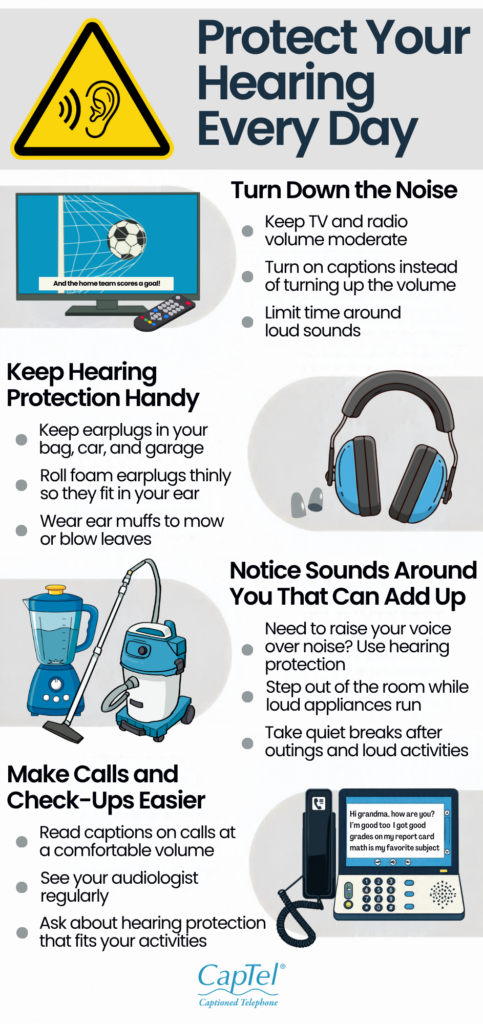
Protecting your hearing every day doesn’t require a lot of time or effort. Simple changes can do the trick. October is National Protect Your Hearing Month, and the infographic below sums up a few small habits and tips to make them part of your everyday routine.
Why It Helps to Protect Your Hearing Every Day
Many types of hearing loss happen gradually, and loud noise can add to those changes over time. According to the National Institute on Deafness and Other Communication Disorders (NIDCD), sounds at or below 70dB are unlikely to cause hearing loss, while long or repeated exposure to sounds at or above 85dB can cause damage.
Protecting your hearing does not mean living in a quiet bubble. It simply means noticing which sounds are too loud or last too long, then making adjustments. Think of it like wearing sunscreen: you still get to enjoy the sunshine, just with a little protection.
Keep the Volume at a Comfortable Level
When sounds are hard to hear, the natural reaction is to turn up the volume on the TV, radio, or headphones. Over time, though, loud listening can add to the strain on your ears. Keeping the volume moderate and limiting how long you listen to loud sound are two of the simplest habits you can build.
Pairing a moderate volume with closed captions can help. Instead of turning up your favorite show, you can read along and keep the volume at a level that feels comfortable.
Keep Hearing Protection Within Reach
Loud moments often sneak up on you. Running the lawn mower or leaf blower, using power tools, cheering at a football game, or watching a fireworks show can all be dangerously loud. Keeping a pair of foam earplugs in your bag, car, and garage means they are there when you need them.
Earmuffs are easy to slip on and off, while earplugs are small and simple to carry. Either can help, as long as they fit well. Foam earplugs work best when they are rolled thin and allowed to expand fully in the ear.
If you wear hearing aids, it is worth knowing that hearing aids are not the same as hearing protection. Your audiologist can suggest how to handle noisy situations, since some people remove their aids and use earplugs, while others use options designed for their devices.
Give Your Ears Regular Quiet Breaks
Your ears appreciate rest, just like the rest of your body. After a lively family dinner, a busy restaurant, or an afternoon at a sporting event, it may help to give yourself some quiet time. A peaceful walk, reading a book, or sitting outside with a cup of tea all count.
Quiet breaks can also help with listening fatigue, the tired feeling that comes from concentrating on hard-to-follow conversations. Building a little calm into your day can be good for both your ears and your mental health.
Notice the Everyday Noises That Add Up
Loud noise is not only a concern at concerts. Kitchen blenders, vacuum cleaners, hair dryers, and woodworking projects can reach noise levels that add up over time.
You do not need a special meter to get started. A simple rule of thumb: if you have to raise your voice for someone nearby to hear you, it is probably loud enough to reach for protection or step away.
Small changes can minimize the impact of these sounds. Running loud appliances for shorter stretches, stepping into another room while the vacuum or blender runs, or choosing quieter settings on a hair dryer can all lower your daily exposure.
Make Phone Calls Easier on Your Ears
Phone calls are a common place where people with hearing loss press the receiver tight against their ear and turn the volume all the way up. That can be tiring and uncomfortable over time.
A captioned phone shows written captions of what the other person says, so you can read along at a volume that feels comfortable. Our guide to types of hearing loss and how they affect phone communication explains why calls can feel harder than face-to-face conversation.
Check In with Your Audiologist Regularly
An audiologist is a hearing care professional who tests your hearing and helps you find the right devices and strategies. Regular visits help you track changes and update your plan as your needs shift.
Before your next appointment, it can help to write down a few questions, such as which hearing protection works with your hearing aids, whether custom earplugs make sense, or which settings help in noisy places. Our guide to hearing health FAQs covers other common questions. October is also Audiology Awareness Month, which makes this a natural time to book a visit.
Every small habit counts. Turning on captions, tucking earplugs in your pocket, and giving your ears a quiet moment when you can all help protect the hearing you have, so the sounds and conversations you enjoy stay a little easier to catch this season and in the years ahead.
Take the next step:
- Learn how a CapTel captioned telephone lets you read along during calls at a volume that feels comfortable
- Find out which CapTel phone model might be the best fit for you or someone you care about
- See if you or someone you care about may be eligible to receive a CapTel phone
- For questions or to learn more, call CapTel at 1-800-233-9130
Keep exploring: More on phones for hearing loss | Visit the CapTel blog | Share this article with a friend

CapTel® is the inventor and technology leader in Captioned Telephones for people with hearing loss. CapTel phones show word-for-word captions of everything a caller says, helping those with hearing loss stay connected with the important people in their lives.