From the stands to the living room, small adjustments make game day easier to follow and more fun.
AT A GLANCE
- Pick Your Seat With Sound in Mind
- Bring Hearing Protection to Loud Venues
- Ask About Assistive Listening at the Venue
- Set Up the Living Room for Easier Watching
- Make Watch Parties Work for Everyone
- Follow the Game Without Relying on Audio
- Keep the Post-Game Call Easy
Fall sports have a sound all their own. The marching band warming up, the crowd noise building through the fourth quarter, the neighbor shouting at the television two houses down.
That noise can be part of the fun, and it can also make watching fall sports challenging for people with hearing loss . Announcements may get lost, conversation in the stands becomes a difficult, and the commentary at home disappears among cheering and conversations around you. Here are practical adjustments for the stadium, the living room, and everywhere in between to help you enjoy the sports season.
Pick Your Seat With Sound in Mind
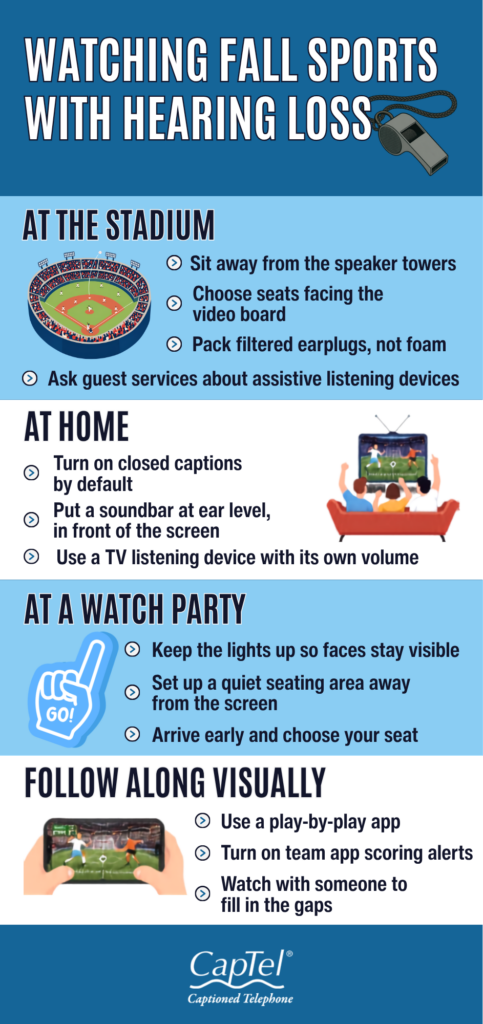
Where you sit can change the experience considerably. In a stadium, seats near the band, the student section, or the speaker towers deliver the most volume and the least clarity. Sitting a section or two away from those areas usually gives you a better balance.
Sightlines matter as much as sound. Seats with a clear view of the scoreboard and video board let you follow the game visually when the audio may be difficult to hear, which is often the difference between tracking a play and guessing at it. Some stadiums include captioning on their scoreboards to help you follow along. Aisle seats also give you an easier exit if you want a break from the noise, and a few minutes in a quieter concourse partway through can make the second half considerably more enjoyable.
Bring Hearing Protection to Loud Venues
This one is counterintuitive but important. Stadium noise regularly reaches levels that can damage hearing, and protecting the hearing you have is important.
Foam earplugs work, though they muffle everything equally. Filtered or musician’s earplugs lower the overall volume while keeping speech clearer, which tends to be the better choice for a game. If you wear hearing aids, talk with your audiologist about how to manage very loud environments, since some devices have settings designed for exactly this situation.
Ask About Assistive Listening at the Venue
Many stadiums and arenas provide assistive listening systems. Guest Services is usually the place to ask, and the equipment is typically available at no charge with a form of ID.
Calling ahead or doing research on the venue website is often faster than asking at the gate. It is also worth asking whether the venue offers captioning on the video board or through a mobile app, since a growing number of larger venues now caption announcements and safety information. Our overview of different alert methods for people with hearing loss covers similar tools you may find useful in public spaces.
Set Up the Living Room for Easier Watching
Home viewing gives you far more control than watching the game in person, and a few changes make a noticeable difference.
Closed captions are one of the most useful setting on the television, and most broadcasts caption live sports. Turning closed captions on by default means you never miss the first drive while hunting through a menu.
Speaker placement matters too. Television speakers often point downward or backward, which sends sound away from you. A soundbar at ear level, positioned in front of the screen, improves clarity substantially. Some assistive listening devices designed for television let you control your own volume independently of everyone else in the room, which solves the most common household argument of the season. Our roundup of the best assistive listening devices for TV walks through the options.
Make Watch Parties Work for Everyone
Watch parties are where hearing loss tends to be most noticeable, because you are competing with the broadcast, the room, and the kitchen all at once.
A few host-side choices help. Keeping captions on lets people follow the game at a lower volume. If you have room, setting up a second seating area away from the main screen gives guests a place to have a quieter conversation. Good lighting helps anyone who reads lips or watches facial expressions.
If you are the guest rather than the host, arriving a few minutes early lets you pick a seat before the room fills. It also gives you a chance to mention what helps you communicate best, which most hosts are glad to accommodate.
Follow the Game Without Relying on Audio
Plenty of fans follow games primarily through visual information, and the tools for it have gotten better over time.
Live play-by-play through a sports app gives you the down, distance, and result in text, often faster than the broadcast delay. Team apps frequently push scoring alerts and drive summaries. At the stadium, the video board and the scoreboard carry most of what the public address system announces.
Watching with a trusted person who will fill in gaps is also helpful. A quick “penalty, offense” is often all you need to stay with the game.
Keep the Post-Game Call Easy
For a lot of people, the call afterward is the best part. Talking through the exciting plays with someone who watched it too is half the reason to follow a team at all.
To make those calls easy, a captioned telephone displays written captions of what the caller says, so you can follow the whole conversation without asking anyone to repeat themselves.
Enjoying game day with hearing loss is mostly a matter of setting things up in advance. Pick the seat, bring the earplugs, turn on the captions, and enjoy the season. Game on!
Take the next step:
- Explore CapTel phone models built to make everyday calls easier to follow
- You or someone you know may be eligible to receive a CapTel phone at no cost
- Have questions? Call CapTel at 1-800-233-9130
Keep exploring: More on telephone devices for hard of hearing | Visit the CapTel blog | Share this article with a friend

CapTel® is the inventor and technology leader in Captioned Telephones for people with hearing loss. CapTel phones show word-for-word captions of everything a caller says, helping those with hearing loss stay connected with the important people in their lives.